Tucson venue La Rosa began as a Benedictine sanctuary built in the Southwestern border town back in 1939. Though it no longer serves as a religious venue in the traditional sense, the religion of sound lives on there, as evidenced by Southern Arizona ambient composer Steve Roach’s new live album, La Rosa: Live In Tucson, out on June 5 via Projekt Records.
Across the recording’s two volumes, Roach evokes "shifts in time and space and perception" and Joseph Campbell’s philosophy of the hero’s journey, taking listeners on an auditory sojourn with shamanic intent.
Recorded live on December 6, 2025, as visual projections by electronic visual artist Sean Hellfritsch, aka Cool Maritime, bathed Roach in light in the cathedral setting, the recording draws from Roach’s back catalog: from early dawn of the new age classics like 1984’s Structures From Silence and 1988’s Dreamtime Return, to more modern compositions, like the title track of 2024’s Spirals of Yearning.
In a space suffused with the psychic spiritual energy of "sixty or seventy years of Benedictine sisters praying all day in here," Roach says his music opens up alternative spiritual vistas, something seeking listeners crave—even as interest in strictly traditional religion declines.
"I deeply feel from performing in these spaces over the years that this creates a connection during the concerts to something bigger than us, something that we can’t explain, but we know it’s there in our hearts and souls," Roach says. "These structures of devotion were built to contain and inspire this. All this collective intention and energy infused over the years in these spaces along with the magnificent acoustic reverberant space and the gathering of the audience, it’s like sharing a collective dream."
Noting performances in other sacred spaces across the US, including the historic Grace Cathedral in San Francisco and the Church of the Heavenly Rest in NYC, Roach says it always feels like an honor to perform in these spaces.
"For the audience to have the history they have with that music, and then hear it live in cathedrals, that in itself is a religious experience for me," Roach says. “For me, religion in this context is the worship of sound, emotion, life and all that comes through in this setting, without the attachment of any particular discipline of a religion. It’s my devotion to the soundcurrent.”
This August, Roach returns to La Rosa, as part of the three-day Soundquest Festival, Friday, August 28- Sunday, August 30th. The festival pairs Roach and other atmospheric sound crafters with heavy metal bands like Blood Incantation and Pallbearer.
Our conversation starts there, as Roach explains his attraction to heavy music.
Steve, it’s interesting to hear about your interest in heavy music, stuff like your collaborators Blood Incantation, who play progressive death metal, and Pallbearer, both of whom are scheduled to join you at the Soundquest festival. What draws you to those extreme sounds?
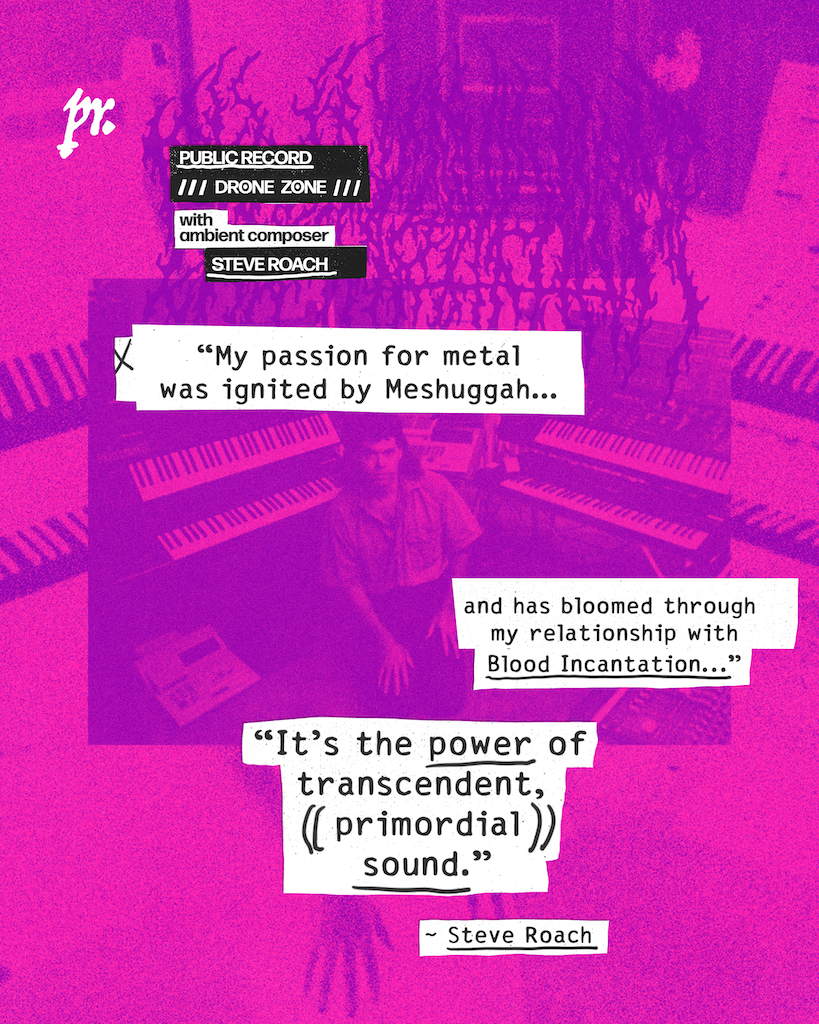
Well, it’s the power of transcendent, primordial sound. My passion for metal was ignited by Meshuggah and has bloomed through my relationship with Blood Incantation. I opened some shows and worked with them, and then I ended up helping Morris Kolontyrsky, their guitarist, get an album deal and I worked on his album Origination with him; it’s out on Projekt.
You talk to these guys and they are so interested in traditional ambient and new age, it’s amazing. Paul Riedl, Blood Incantation’s singer and one of the vocalists, releases music under his own name. If you heard it 20 or 30 years ago, you’d think it was Iasos. It's peaceful, "dawn of the new age" sounding stuff.
I find myself thinking about how receptive the metal underground is to music outside of that genre, including jazz, prog and new age, these very distinct genres. They seem open to all that stuff in ways they aren’t often given enough credit for.
Absolutely. I first met Blood Incantation at The Rock. I got a call from Wooden Tooth Records saying “These guys just bought Structures from Silence, they’re big fans.” So I said, “Well I’m driving up.” Within a couple hours we were hanging out. I was on the tour bus and they’ve got Structures and Dreamtime, and I became a huge fan of their stuff.
I love that stuff. Meshuggah is my number one, forever.
Right now, I’m doing a piece with a large format modular. It’s so intense. I’m gearing up to do this kind of thing with Blood Incantation on a future record. It’s analog sequencing but it’s absolutely raging. It has that feeling of just being hosed off with a giant fire hose. [Laughs]
The La Rosa record is really awesome. Would you mind telling me about your attraction to playing spaces like La Rosa, a former Benedictine monastery built in the 1930s? What is it about playing spaces known for being holy, spaces for worship and spiritual contemplation, that speaks to you?
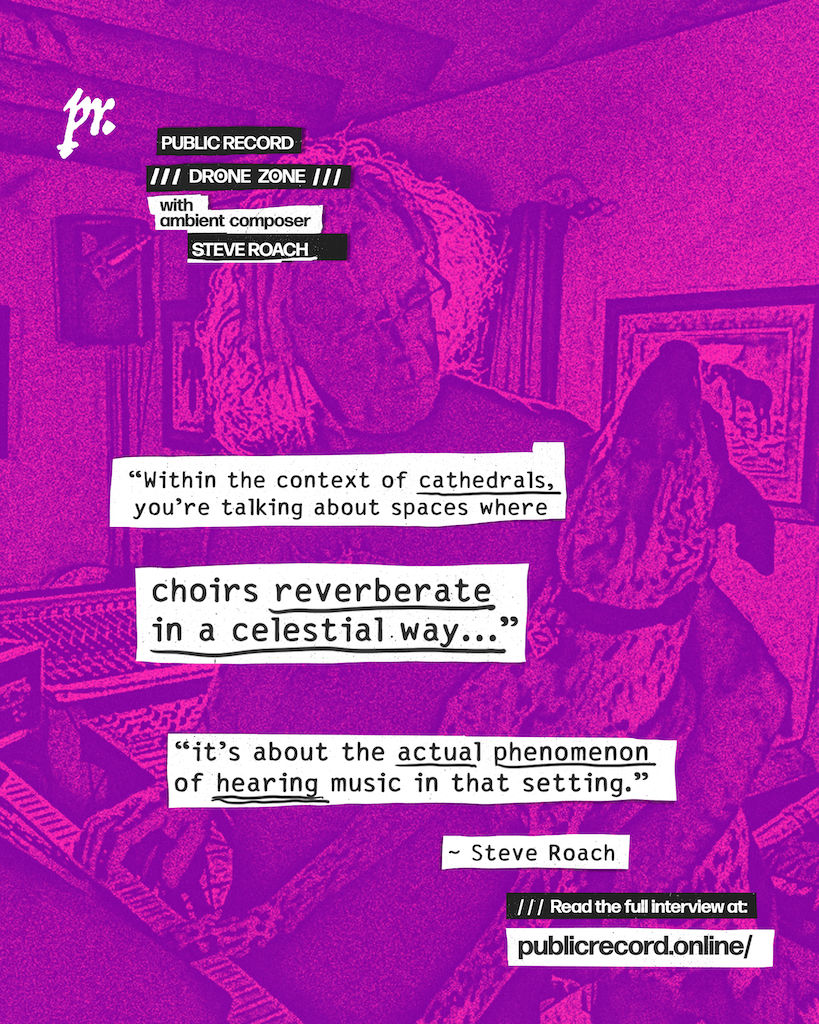
The actual setting, the space, the architecture. What places like that were designed for is what we all want: to be inspired at a level beyond ordinary daily perception. You want to be in a place where you’re expanded. Within the context of cathedrals, you’re talking about spaces where choirs reverberate in a celestial way. Organ performances take on a visceral, overpowering feeling.
A lot of times when I’m playing these kinds of spaces, the organist will be in there tuning up while I’m setting up, and it’s about the actual phenomenon of hearing music in that setting. I’ve heard artists like Jan Garbarek in that kind of setting. I’ve heard different kinds of music in that setting. My own music in that setting…well, I go to great lengths to create sound space in my humble little studio setting.
The Timeroom.
Right. With reverb, you can create an exaggerated space, one not comparable to the structures built on this planet. There’s no limitations of space. That’s what I’m always going for, something that removes the structures that contain us. Not all the music, but certainly with the diaphanous breathing kind of music I do.
From the beginning, a lot of the sound design, the elements I work with, what my instincts are drawn to, is creating very big sounding pieces and spaces and environments and emotional realms to be in.
Churches and spaces like that are absolutely perfect for new sacred music. The Age of Reflection promoters have been staging these shows in churches all across the country for me, from New York to Chicago to Grace Cathedral in San Francisco. It’s just made to fit, sonically, what I’m doing.
The material on Dreamtime and Structures From Silence, in these churches it sounds absolutely amazing. And for the audience to have the history they have with that music, and then hearing it played in cathedrals, that in itself is a religious experience for me, religion being the worship of sound and emotion and all that comes through at the most pure level, without the attachment of any particular discipline of a religion. It’s the religion of sound.
When you hear “Structures” hovering in these cathedrals, collectively, you hear the audience in the record, the experience of that, it does not get any more complete than that. It’s just absolutely an interesting time, because churches across the country, there’s a certain bankruptcy going on there. A lot of churches are no longer serving as a traditional church. Say in Seattle and Portland, both of those were public performance venues along with services they still do there. But they need to keep money coming in. And these are churches that are progressive, bringing in all the aspects of today’s culture, the gay and lesbian communities, the LGBTQ culture.
Openness to all that comes along with openness to what you’re doing, culturally. It’s of a piece. It’s not about one sonic cloth or one particular religion, but open spiritual expression. It’s like they say people may be giving up on religion, but religion hasn’t given up on people, if you get my drift.
It’s people’s passion—wanting to feel a connection to each other and something bigger than us. Something that we can’t explain, but we know it in our hearts and souls. Those buildings were meant to contain that. All that collective intention and energy builds up. You had the Benedictine sisters praying in La Rosa every day for 60 or 70 years; it’s built up in there. All of that for me, it just works so well to my advantage as I pull out all the Oberheims and didgeridoos and fujara [flutes] and Aztec death whistles.
The intention I go in there with is drawn from Joseph Campbell’s framework of a heroic journey. A journey of life. As you hear, there are a lot of passages, some dark, narrow realms you move through, then they resolve and you end up in the realm of “Structures.”
The visuals Cool Maritime provided that evening, how do you interact with them on stage? You use the Joseph Campbell heroic definition, but I’m thinking of a heroic dose in psychedelics, where you’re on a journey. You do that with the music. Do the visuals aid you in conjuring a shamanic vibe?
It’s 100% a shamanic thing. That’s at the core of what drives me to do this sort of thing. To create these shifts in time and space and perception and do it in a way where everyone can perceive it in their own way.
With Sean [Hellfritsch], we did two shows in Seattle and Portland two years ago. I saw what he was doing. I’ve also worked with visual artist Eric Epstein. They know my sets; with Sean, he absolutely got into it right when we first met. I trusted him. I gave him the set list and provided him with the music.
He’s more or less performing to my set. I’m not performing to his piece, but it creates that visual sonic sacred space, the atmospheric immersion. I’m up there doing my thing and it could be totally dark and I’d be perfectly fine with that. But to have the embrace and aura of that fall upon you when you play…he had that mapped out really beautifully. The cover image of the album is really fiery and that’s when things are really cutting loose. There’s an interplay and mutual intense space to respond to, and I’m feeling immersed and supported by his whole presentation. I’ve also performed in very austere environments, and it’s absolutely effective and more internalized for people, but it’s still there.
Do they bring in additional gear when you’re in there? Are you augmenting the house gear?
Their system is absolutely state of the art. 100% of everyone I talk to—including metalheads—have said they have never experienced anything like that. I know that sub energy is really state of the art at La Rosa. People haven’t heard my music with that kind of sub energy in there.
People have never imagined my music at that volume level. Playing it through concert speakers, you can shape and carve the low end, and really feel what I’ve got. That’s the beauty of these kinds of spaces. But it’s not so overpowering that if you’re a more sensitive listener; it works in any case. I often have speakers I put in the rear as well, to create a surround experience. Those are monitored from the board in the back. It’s more subtle but especially in the parts of my set where there’s more delicate, almost ASMR elements, when they are lighting up the air, it transforms it.